


- 首頁
- Blog
- A New Era for ChatGPT Ads: Will the Next Generation of Online Promotion Strategies Enter the Realm of "Conversational Marketing"?
A New Era for ChatGPT Ads: Will the Next Generation of Online Promotion Strategies Enter the Realm of "Conversational Marketing"?
Remember when many people used to say: "ChatGPT will replace Google because it has no ads, people will prefer it." Unfortunately, that statement has now been officially debunked...
On January 16, 2026, OpenAI announced it would begin testing ChatGPT's advertising feature in the US market within the coming weeks. The aim is to allow more people to use AI at an affordable price while balancing privacy, trust, and answer quality. This news not only sparked public attention and heated discussion but also led many businesses to ponder: Will the launch of ChatGPT ads create new business opportunities and improve the online advertising marketing landscape?
Why Did ChatGPT "Suddenly" Start Selling Ads?
Although many felt this advertising plan came out of the blue, clues were already present given OpenAI's financial pressures and industry developments.
1. High Operational Costs and Sustained Loss Pressure
OpenAI recorded an operating loss of approximately $7.8 billion in the first half of 2025, with projections suggesting the loss could widen to around $14 billion in 2026.
Despite OpenAI's annualized revenue surpassing roughly $20 billion in 2025, it's still insufficient to cover massive R&D, operational, and AI infrastructure investment costs. Some analysts even suggest that if the current cash-burn rate continues, OpenAI could exhaust its cash reserves by mid-2027.
This implies that relying solely on subscription fees and enterprise solutions cannot sustain the computational needs and expansion of super-large-scale models in the long term, making the introduction of ad revenue an almost inevitable choice.
2. From "Hating Ads" to "Embracing Ads"
CEO Sam Altman once publicly stated that advertising was the "last resort" for OpenAI's business model, fearing ads could undermine user trust in the objectivity of responses.
However, by 2025, he began softening his stance, indicating he wasn't completely opposed to ads but emphasized they must be carefully designed to avoid making money through "addictive mechanisms" like traditional platforms.
As financial pressure mounted, OpenAI ultimately and reluctantly chose to introduce ads into the free version and lower-tier plans, making advertising a crucial revenue source to subsidize computational costs and maintain free access.
3. Targeting the Vast Digital Ad Market and "Intent-Based" Traffic
Analysis points out that Google Search + YouTube annual ad revenue is around $300 billion, while Meta's Facebook + Instagram has about $180 billion, demonstrating the proven commercial value of search and social platform ads.
ChatGPT conversations often possess a high degree of "purchase intent," such as "Help me plan a 5-day Seoul itinerary" or "Recommend accounting software suitable for a small business." This reflects demand and budget much more clearly than scrolling through social media posts.
In other words, ChatGPT holds a batch of highly commercially valuable "intent-based conversations." Once ads are executed precisely, there's an opportunity to capture a share of the existing search and social ad budgets.
Businesses Wanting to Enter the New Online Promotion Market: Understand the "Rules of the Game" Before Advertising
Understanding official guidelines is the starting point for any online promotion strategy. OpenAI has detailed the principles and testing methods for ad integration on its official webpage:
1. Only on Specific Plans in Specific Regions
In the initial phase, ChatGPT ads are only being tested in the US market, targeting logged-in adult free users and ChatGPT Go users. ChatGPT Plus, Pro, Business, and Enterprise subscription plans will show no ads to maintain a clean experience.
Interpretation: For businesses, this means ChatGPT ads are currently more suitable for targeting the "general consumer segment" and SME users, rather than large clients who have already purchased enterprise-grade services.
2. Ad Placement and Labeling Methods
Ads will appear at the bottom of ChatGPT's responses, displayed only when the conversation content is highly relevant to the sponsored product/service. All ads will be clearly labeled as "Sponsored" content and visually separated from AI responses to avoid confusion.
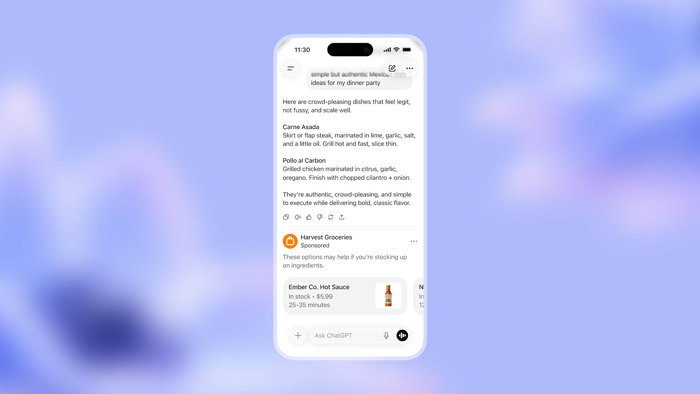
Interpretation: This design of "below the response + clear labeling" makes the ad experience closer to search ads: providing a potential solution entry point after the user has already posed a clear question.
3. Ads Don't Influence Answers; Conversations Aren't Sold to Advertisers
OpenAI lists several core principles, including:
Answer Independence: Ads will not influence ChatGPT's response content. All answers still prioritize being "most helpful to you."
Conversation Privacy: Chat conversation content will not be disclosed to advertisers, nor will personal data be sold.
Choice and Control: Users can review why they saw a particular ad, close that ad, turn off personalization settings, and can completely remove ads via paid plans.
Interpretation: Businesses cannot directly "read" user conversations or personal data through ChatGPT ads. They can only reach potential customers through the platform's existing audience segmentation and relevance matching.
4. Restrictions on Sensitive Topics and Underage Users
During testing, ads will not be shown to accounts explicitly or inferred to be under 18 years old. Ads will also not be displayed near sensitive or regulated topics like health, mental health, or politics.
Interpretation: If a business's ad involves medical, political, or highly sensitive categories, it might be unable to run on ChatGPT and may need to seek other platforms.
5. Advertising Experience Goal: Useful, Interesting, Not "Sticky"
OpenAI emphasizes that their goal is not to increase user dwell time but to maintain long-term trust and a good experience. Good ads should be "useful and interesting," helping users discover new products and services.
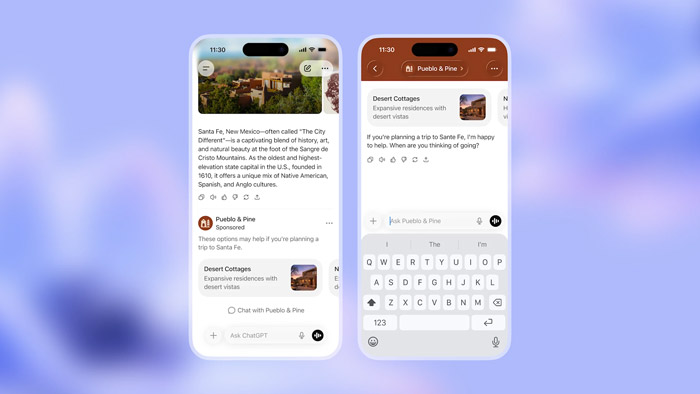
Interpretation: As AI capabilities continue to advance, OpenAI will gradually develop ad experiences that better fit needs, moving beyond static messages or links. For example, in the future, users might be able to directly ask questions upon seeing an ad to assist in making purchase decisions.
What is the Significance of ChatGPT Ads for Businesses' Online Promotion?
For brands and SMEs, ChatGPT ads aren't just about adding another "ad placement." Instead, they introduce a brand-new "conversational online promotion" scenario.
From "Keywords" to "Real-World Context"
Traditional search ads often rely on keywords like "Seoul free travel" or "accounting software recommendation." ChatGPT ads lean more towards natural language needs: "Help me plan a 5-day family trip to Seoul" or "I have a 5-person company and want to find simple, easy-to-use accounting system."
For the platform, this contextual information makes it easier to infer:
- The current demand scenario (travel, independent travel, family, B2B tools)
- Spending power and budget range (e.g., "small business," "cheap but reliable")
- Decision stage (information gathering, solution comparison, preparing to purchase)
Although advertisers cannot directly see these conversations, the platform can, based on conversation context, deliver your ad precisely to users "already thinking about solutions in your category."
A Potentially "Leveling-the-Playing-Field" Tool for SMEs
OpenAI notes that the combination of ads and AI tools presents an opportunity for small businesses and new brands to shorten the gap with large brands in creating high-quality content and experiences.
This is because businesses don't necessarily need a large marketing team. If they understand how to set up their product positioning and copy, they can gain exposure through ChatGPT's high-intent traffic. The conversational interface places greater emphasis on "problem-solving" rather than mere brand awareness, helping SMEs with outstanding functionality and experience to stand out.
How Can Businesses Achieve Commercial Goals Through ChatGPT Ads?
How should businesses integrate ChatGPT ads into their existing online promotion strategies to actually drive sales and brand growth?
1. Define Your "Conversation-Scenario-Based" Objectives
On ChatGPT, users aren't scrolling a timeline; they're asking questions proactively. To leverage this, first translate your marketing objectives into "conversation scenarios":
For a travel brand, don't simply set the goal as "increase sales of Korea tour packages." Instead, focus on "when someone asks for Seoul itinerary suggestions, have my brand appear among relevant options."
For SaaS or accounting software, change the goal of "increase software usage" to "when small businesses ask about accounting or invoicing tools, my product is one of the recommended options."
This approach can help in subsequently designing ad copy and landing pages that closely align with the common questions and contexts users express in ChatGPT, rather than relying solely on brand slogans.
2. Optimize Your Ads and Content for "Problem-Oriented" Queries
ChatGPT users are accustomed to starting with questions, so online promotion strategies should also be problem-oriented:
In ad headlines or descriptions, directly address common questions, like "Planning a 5-day family trip to Seoul? Decide these 3 things first" or "For companies with 5 or fewer people, this accounting system is sufficient." Simultaneously, landing page content should continue the logic of these questions, not jump to entirely different marketing language.
A simple formula to help craft suitable ad plans:
`The sentence a user asks in ChatGPT → Your ad headline responds → The landing page provides specific solutions and next steps`
This consistency from conversation to conversion can reduce mid-funnel drop-offs, making ChatGPT ads a true starting point for the sales funnel, not an isolated impression.
3. View ChatGPT as a "Decision Aid," Not a Single Point of Exposure
OpenAI's vision is for users, after seeing an ad, to continue using ChatGPT to inquire about and compare products, gradually moving closer to a purchase decision.
Therefore, in formulating online strategies, you can:
Provide clear, honest comparison content on your website and product pages, giving ChatGPT sufficient material to present your brand or product's advantages when sourcing public information.
Ensure FAQ sections, usage guides, and reviews are structured clearly, facilitating AI understanding and organization.
In other words, SEO and content marketing remain important, but they upgrade from "optimizing for search engines" to "optimizing for AI assistant comprehension and citation."
4. Integration with Other Online Promotion Channels
ChatGPT ads won't replace existing channels; they're more like a "high-intent conversation entry point." Therefore, treating them as a new node and connecting them to the existing marketing funnel—rather than operating them independently—is key to seeing overall ROI improvement:
Pair with Search Ads: Use search ads to capture keyword traffic; use ChatGPT ads to capture users looking for solutions using natural language.
Complement with Social Ads: Use social media for "seeding interest," "brand storytelling," and emotional connection; use ChatGPT to appear when users start seriously comparing solutions.
Integrate with EDM/CRM: Nurture potential leads acquired through ads via Email and marketing automation on the backend, extending the customer lifecycle.
5. Prioritize User Experience, Avoid "Ad Backlash"
Market research analysis indicates that if ChatGPT ads overly disrupt the experience, users might migrate to competitors without embedded ads (e.g., Google, which has currently stated it won't directly insert ads in Gemini for now).
This serves as a reminder for businesses: don't treat ChatGPT ads as a place for "flooding exposures." Instead, focus on highly relevant, high-value messages. Ads that don't align with the user's current conversation context, even if displayed, are easily closed or can generate disgust.
A truly effective strategy is to view ChatGPT ads as "part of the service"—providing helpful solutions when the user needs them, not as interruptive sales pitches.
The launch of ChatGPT ads signifies AI platforms officially entering a new era of online promotion. For businesses, this is not just a new exposure channel but also an excellent opportunity to build brand trust and improve conversion rates. In the future, businesses skilled at leveraging ChatGPT ads will be able to seize the initiative in digital marketing competition and achieve deeper commercial objectives.
MORE BLOG
-
World's Strongest Open-Source AI Shakes the Industry? How Enterprises Can Use Kimi K3 to Reshape Digital Marketing and Web Development
2026/07/24 Discover how Kimi K3, the 2.8T parameter open-source AI model, empowers Hong Kong businesses with powerful web code generation, GEO-optimized content, and cost-effective digital marketing transformation. -

IG Blocked or Shadowbanned? HK Brand Rescue & Prevention Guide (59 characters)
2026/07/21 Instagram account reported, locked, or action blocked? Learn the 5-step SOP to appeal, bypass Shadowban, and protect your brand asset in Hong Kong safely. -
Can Generative AI Search Sell Ads Too? Demystifying How Google AIO Ads Differ from Traditional Google Ads
2026/07/15 Discover how Google AIO (AI Overviews) is changing digital marketing. Learn the 4 key differences from traditional Google Ads and 5 tactics to prepare.

