


- 首頁
- Blog
- [2026 Social Media Marketing Trends] What is IG Trial Reels? The Secret Weapon to Reach More Non-Followers
[2026 Social Media Marketing Trends] What is IG Trial Reels? The Secret Weapon to Reach More Non-Followers
2026 / 02 / 03
In the ever-changing world of social media marketing, Instagram remains a crucial battleground for businesses and brands vying for attention. To better align with user preferences and commit to building a more comprehensive social platform, Instagram continuously rolls out new features, offering users more novel and engaging experiences. A prime example is the "Trial Reels" feature launched in late 2024, which has become a secret weapon for brands and creators to reach audiences beyond their existing followers.
This article will provide an in-depth analysis of Trial Reels' operational mechanics, practical applications, and strategic adjustment mindsets, helping you navigate the waves of the IG algorithm with steady progress.
Here are the specific differences between Trial Reels and regular Reels:
In simple terms, Trial Reels act as a "safe sandbox" within the content lab, allowing users to boldly experiment with entirely new topics, different video styles, or more experimental opening hooks without worrying about poor performance metrics affecting their image among core followers or their account's algorithmic weight.
Beyond reducing trial-and-error risk, Trial Reels offer several other practical advantages:
Safely Test New Content Directions: If you're considering shifting from knowledge-sharing to humorous skits, or trying a completely new product demonstration style, you can use Trial Reels to gauge audience reaction, avoiding potential follower loss due to a style change.
Precisely Optimize the Critical Opening Seconds: The opening of a video determines if viewers will continue watching. Through Trial Reels, you can conduct A/B tests on the same topic using different opening formats (e.g., question-based, conflict-driven, or result-teaser) to quickly identify the presentation style most likely to hook unfamiliar viewers.
Explore New Audience Perspectives: Even for the same product, content can be designed for different demographics, such as audiences seeking "cost-effectiveness" or those valuing "aesthetic living." Testing different narrative angles via Trial Reels can uncover potential new customer segments.
Gauge Account Health & Reach Limitations: This can be considered a hidden function of Trial Reels. If you find that your Trial Reels are barely reaching even "non-followers," it might be a warning sign that your account is facing overall reach restrictions. It's advisable to check your account's positioning, content consistency, or engagement status for a comprehensive adjustment.
— Account type is "Professional Account" or "Creator Account"
— Account is set to Public
— Follower count exceeds 1000
Then, when publishing a Reel as usual, you'll notice a "Trial" button appear in the interface. After clicking this button, the Reel will be published in "Trial" mode, entering a testing phase shown only to non-followers.
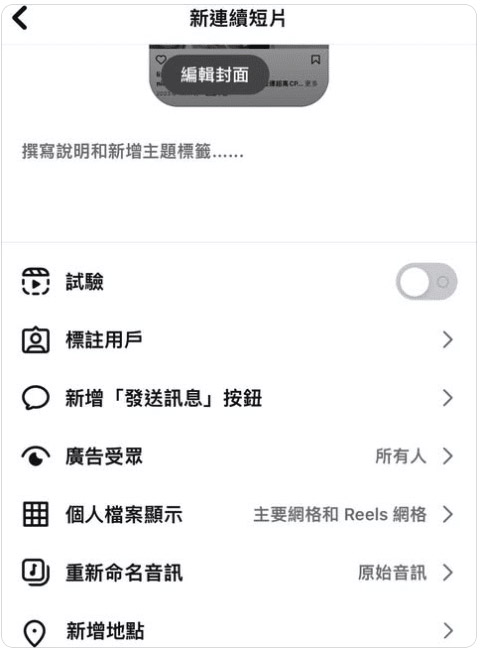
After approximately 24 hours, you can view the performance data of that Trial Reel in Insights. If the data is promising (e.g., high completion rate, strong engagement), you can manually choose "Share with Followers" to convert it into a regular Reel, pushing it to all your followers.
Alternatively, you can enable the "Auto-Share" function. If the video meets performance thresholds after 72 hours, the system will automatically convert it to a regular Reel and make it public to all followers.
While Trial Reels offer many benefits and their performance does not affect your account's overall rating, some details require attention during use:
Compare Data Correctly: Do not directly compare the view count of a Trial Reel with that of regular Reels. Since Trials are pushed only to non-followers, reach numbers will naturally be lower. It's recommended to compare different Trial Reels against each other to find the best-performing version.
Adhere to the Testing Purpose: Instagram has indicated that abusing this feature (e.g., publishing a large number of similar videos in one day, or posting content identical to your usual style) may be detected by the system and lead to reduced reach. It's best used for genuinely testing new, differentiated content directions.
Are the captions clear and readable? — Most users watch with sound off; captions that are too small, dense, or fast can cause viewers to leave.
Is there a significant mismatch between the thumbnail and the actual content? — "Clickbait" might bring clicks but leads to immediate drop-off, harming completion rates.
Is the Call-To-Action (CTA) clear and timely? — Beyond asking for likes, does it guide comments, shares, or link clicks?
Are you repeatedly uploading highly similar versions? — The system may treat this as spam and directly limit its reach.
Are you ignoring the variable of "audience angle"? — For the same product, testing a "solution-focused" angle vs. an "emotional resonance" angle might yield completely different data.
In the competitive social media landscape, timely testing and data-driven decisions are key. Through Trial Reels, brands can not only explore more creative directions but also optimize strategies without their followers' knowledge. Therefore, for businesses aiming to enhance exposure and conversion rates, incorporating Trial Reels into their social marketing plans can make content decisions more precise and strategic.
Arachne Group Limited has years of experience in the social marketing field and can assist brands in developing comprehensive IG marketing strategies—from trialing to formal promotion—ensuring each step maximizes effectiveness. If you are looking for professional social marketing services, please feel free to contact us.
This article will provide an in-depth analysis of Trial Reels' operational mechanics, practical applications, and strategic adjustment mindsets, helping you navigate the waves of the IG algorithm with steady progress.
What are Trial Reels? How do they differ from regular IG Reels?
IG Trial Reels is a short-form video cold traffic testing feature introduced by Instagram. When you enable this feature to publish a Reel, the video is not initially pushed to your existing followers nor does it appear in your profile grid. Instead, it is specifically shown to "non-follower" audiences who haven't yet followed you. The system collects interaction data (such as watch time, engagement rate) from this unfamiliar audience within 24 to 72 hours, allowing you to evaluate the content's appeal before deciding whether to officially release it to all your followers.Here are the specific differences between Trial Reels and regular Reels:
| Trial Reels | IG Reels | |
| Primary Audience | "Non-followers" only | Mix of followers & non-followers |
| Shown on | Profile No (hidden state) | Yes |
| Primary Purpose | Test new content's appeal/effectiveness with cold traffic | Publish polished content, pursue max exposure & interaction |
| Risk/Impact | Very low; data doesn't affect account's overall algorithm rating | Performance directly affects account reach & algorithm evaluation |
| Marketing Role | Strategic pre-publishing experiment & optimization tool | Regular content publishing & engagement channel |
In simple terms, Trial Reels act as a "safe sandbox" within the content lab, allowing users to boldly experiment with entirely new topics, different video styles, or more experimental opening hooks without worrying about poor performance metrics affecting their image among core followers or their account's algorithmic weight.
The Many Benefits of IG Trial Reels: Why It's a Secret Weapon for Reaching Non-Followers
Instagram CEO Adam Mosseri has clearly stated that the performance of "Trial Reels" does not affect an account's overall rating. This is a significant boon for creators, effectively lowering the cost of experimenting with new content. Especially for creators who enjoy freeform creation, they can first test audience reaction via Trial Reels before deciding whether to formally publish the full content.Beyond reducing trial-and-error risk, Trial Reels offer several other practical advantages:
Safely Test New Content Directions: If you're considering shifting from knowledge-sharing to humorous skits, or trying a completely new product demonstration style, you can use Trial Reels to gauge audience reaction, avoiding potential follower loss due to a style change.
Precisely Optimize the Critical Opening Seconds: The opening of a video determines if viewers will continue watching. Through Trial Reels, you can conduct A/B tests on the same topic using different opening formats (e.g., question-based, conflict-driven, or result-teaser) to quickly identify the presentation style most likely to hook unfamiliar viewers.
Explore New Audience Perspectives: Even for the same product, content can be designed for different demographics, such as audiences seeking "cost-effectiveness" or those valuing "aesthetic living." Testing different narrative angles via Trial Reels can uncover potential new customer segments.
Gauge Account Health & Reach Limitations: This can be considered a hidden function of Trial Reels. If you find that your Trial Reels are barely reaching even "non-followers," it might be a warning sign that your account is facing overall reach restrictions. It's advisable to check your account's positioning, content consistency, or engagement status for a comprehensive adjustment.
How to Use IG Trial Reels? Step-by-Step Guide
Before starting to use the "Trial Reels" feature, ensure your account meets these 3 conditions:— Account type is "Professional Account" or "Creator Account"
— Account is set to Public
— Follower count exceeds 1000
Then, when publishing a Reel as usual, you'll notice a "Trial" button appear in the interface. After clicking this button, the Reel will be published in "Trial" mode, entering a testing phase shown only to non-followers.
After approximately 24 hours, you can view the performance data of that Trial Reel in Insights. If the data is promising (e.g., high completion rate, strong engagement), you can manually choose "Share with Followers" to convert it into a regular Reel, pushing it to all your followers.
Alternatively, you can enable the "Auto-Share" function. If the video meets performance thresholds after 72 hours, the system will automatically convert it to a regular Reel and make it public to all followers.
While Trial Reels offer many benefits and their performance does not affect your account's overall rating, some details require attention during use:
Compare Data Correctly: Do not directly compare the view count of a Trial Reel with that of regular Reels. Since Trials are pushed only to non-followers, reach numbers will naturally be lower. It's recommended to compare different Trial Reels against each other to find the best-performing version.
Adhere to the Testing Purpose: Instagram has indicated that abusing this feature (e.g., publishing a large number of similar videos in one day, or posting content identical to your usual style) may be detected by the system and lead to reduced reach. It's best used for genuinely testing new, differentiated content directions.
What to Do if a Trial Fails? Systematic Adjustment Strategies & Common Error Checklist
A single failed trial is not the end, but a starting point for optimization. Therefore, when a trial fails, the primary task is to troubleshoot and find solutions, such as:Content Design Issues:
Does the opening 3 seconds lack a strong hook? — Unfamiliar viewers have little patience; you must give them a reason to stay within 3 seconds.Are the captions clear and readable? — Most users watch with sound off; captions that are too small, dense, or fast can cause viewers to leave.
Is there a significant mismatch between the thumbnail and the actual content? — "Clickbait" might bring clicks but leads to immediate drop-off, harming completion rates.
Is the Call-To-Action (CTA) clear and timely? — Beyond asking for likes, does it guide comments, shares, or link clicks?
Testing Methodology Issues:
Are you changing too many elements at once? — Simultaneously changing topic, style, editing pace, and tone makes it impossible to know which change worked or failed.Are you repeatedly uploading highly similar versions? — The system may treat this as spam and directly limit its reach.
Are you ignoring the variable of "audience angle"? — For the same product, testing a "solution-focused" angle vs. an "emotional resonance" angle might yield completely different data.
Account Health Issues:
If the reach of even your regular Reels is consistently declining, it's advisable to pause trials and prioritize addressing overall account engagement and content consistency first, to restore algorithm trust.Frequently Asked Questions About Trial Reels
Q1: Does Trial Reels data affect my account's overall algorithm weight/ranking?
A: No. Instagram officially states that Trial Reels data is for creator reference only; its performance, good or bad, is not used to calculate or lower your account's overall rating or algorithmic weight.Q2: Can a Reel in Trial mode be converted to a regular public Reel later?
A: Yes. If the data performs well during the trial, you can manually select "Share with Followers" to make it a public Reel, and it will appear on your profile.Q3: How often should brands use the Trial Reels feature?
A: It's recommended to use it rhythmically, for example, 1-2 times per week or conducting focused tests before major marketing campaigns. The key is to test "meaningful new changes," not to overuse it for publishing.Q4: What types of brands are best suited for using Trial Reels?
A: All brands hoping to break out of their echo chamber, explore new audiences, or test new content directions can benefit. Industries with fast content turnover and a constant need to attract attention—such as beauty/fashion, F&B, travel/lifestyle, education/knowledge, and e-commerce/retail—can see particularly significant benefits.In the competitive social media landscape, timely testing and data-driven decisions are key. Through Trial Reels, brands can not only explore more creative directions but also optimize strategies without their followers' knowledge. Therefore, for businesses aiming to enhance exposure and conversion rates, incorporating Trial Reels into their social marketing plans can make content decisions more precise and strategic.
Arachne Group Limited has years of experience in the social marketing field and can assist brands in developing comprehensive IG marketing strategies—from trialing to formal promotion—ensuring each step maximizes effectiveness. If you are looking for professional social marketing services, please feel free to contact us.
MORE BLOG
-

Xiaohongshu Spotlight Ad Budget Allocation Guide: How to Balance Feeds and Search Ads Ratio?
2026/10/16 Master Xiaohongshu Spotlight budget allocation: Master Feeds vs. Search ads strategy across brand stages to lower CPA and maximize ROI. Learn how to optimize now! -

How to Run Threads Ads? Meta Ads Manager Setup, Creative Specs & Performance Testing Guide for Hong Kong Brands
2026/09/16 Master Threads Ads on Meta Ads Manager. Learn specs, placement rules, native creative strategies, and performance tracking for Hong Kong brands. -

What is GEO? Differences, practices, and measurement methods regarding SEO vs. Generative Engine Optimization.
2026/09/11 Discover what Generative Engine Optimization (GEO) is, how it differs from SEO, key strategies for AI search visibility, and how to measure results.

